
How to Read Your Renewal Report
The renewal lands in your inbox: health up 14%, dental up 9%. You forward it to the owner. Ten minutes later, you get a reply of one word: “Why?”
You open the report. Eleven pages, three tables, and the phrase “credibility-weighted required adjustment.” You have survived a payroll software migration. This should not be the thing that beats you.
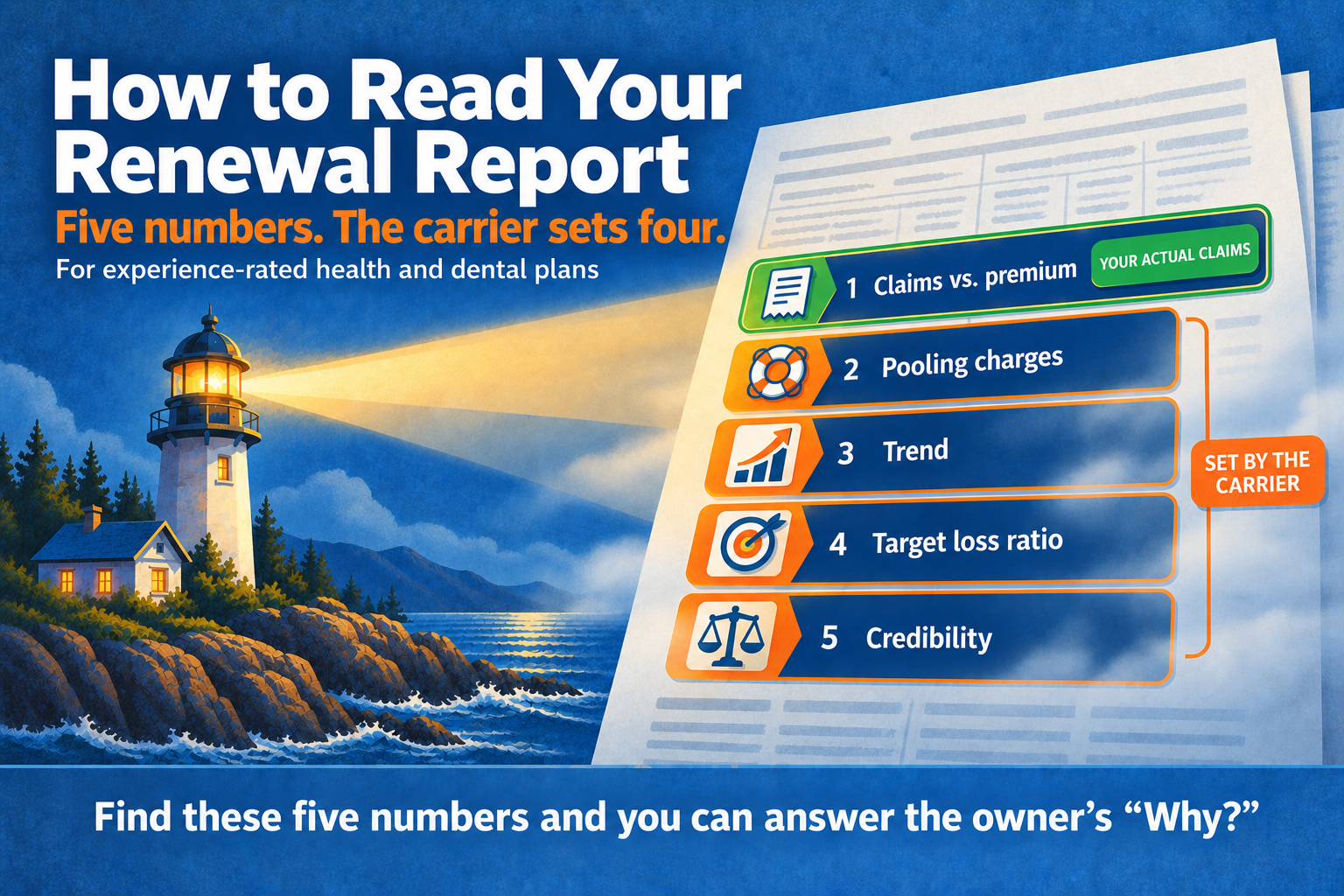
The good news: on an experience-rated plan, where your own claims drive the rate, the health and dental increase comes down to five numbers. Only the first is a record of what actually happened. The carrier sets the other four. It decides what is appropriate, and rarely shows its reasoning.
Claims versus premium. What the plan paid out over the last 12 months, against what you paid in. One catch: the report usually uses “adjusted premium,” which is your premium with the pooling charge taken out. Claims divided by adjusted premium is your loss ratio.
Pooling charges. Pooling is insurance for your insurance. If one person’s claims pass a set amount in a year (the “pooling level,” often around $10,000), the excess is removed from your numbers, so one serious illness can’t sink your renewal. The “pooling charge” is the slice of premium that pays for that protection.
Trend. How much more the carrier says the same claims will cost next year: inflation, new drugs, more usage.
Target loss ratio (TLR). The share of each premium dollar the carrier plans to spend on claims. The rest covers its expenses, its profit and your advisor’s commission. If your target is 80% and you ran at 86%, the increase is closing that gap.
Credibility. How much weight the carrier gives your own claims versus the average of all its clients. A firm of 15 might count for 20%; 200 people, close to 100%.
That’s the math. A good report goes further. Does yours:
show the commission and carrier expenses as actual numbers?
identify trends, such as which benefits are climbing year over year?
flag high-cost drugs (by type, never by person) as a read on the health of your workforce?
benchmark your plan against similar employers, to keep you competitive?
offer plan design and cost control options, with what each would save?
What to do this month:
Pull last year’s report and find the five numbers.
Ask for the carrier’s figures in writing: pooling charges, trend, TLR, credibility and the commission disclosure. Compare them with last year’s.
Write the answer for the owner in two sentences before you’re asked. “Claims ran 86% against an 80% target, and the carrier added 12% for next year’s costs” beats “it went up.”
At BeneCare we rebuild the carrier’s calculation in our own worksheet and keep each year’s figures on file, so we know when one has moved. Every experience-rated renewal we present comes with a one-page summary written for the person who asks “why?”
If BeneCare looks after your plan, that’s already how your renewal arrives. If we don’t, and you’d like a second set of eyes on a report you’re trying to decode, send it over.
The small print: this covers experience-rated extended health and dental only. Pooled benefits such as life and long term disability, fully or partially pooled plans, and Administrative Services Only (ASO, or self-insured) plans work differently and are articles of their own.
Disclaimer: This article is for general information only. It is not insurance, legal, tax, or accounting advice. Legislation and carrier practices can change; please confirm details for your own plan. E&OE.
How to Read Your Renewal Report